
(A Review Worth Reading Slowly)
Some books entertain. Some books inform.
Very few books feel like a long, gentle conversation with someone who has already figured out how to stay calm and kind in a chaotic world.
The Art of Happiness (1998), written by His Holiness the Dalai Lama and psychiatrist Howard Cutler, is one of those rare few.
Over a series of warm, honest conversations, the Dalai Lama repeats one simple but revolutionary idea: the purpose of life is to be happy—and true happiness is something we can train ourselves to experience, no matter what life throws at us.
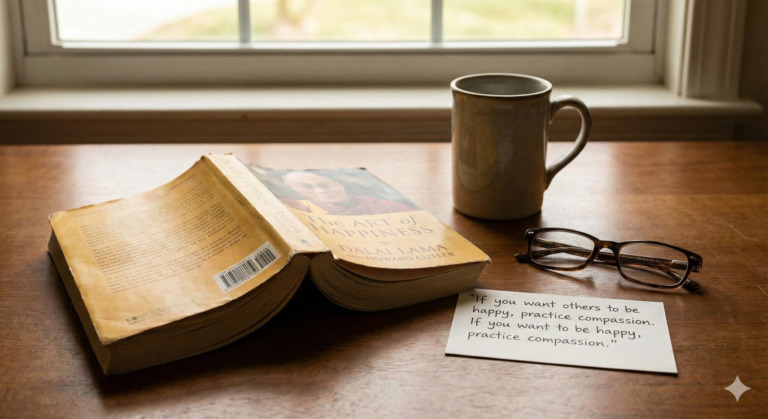
Here is the quote I keep coming back to, the one I have on a small card above my desk:
“If you want others to be happy, practice compassion.
If you want to be happy, practice compassion.”
— His Holiness the Dalai Lama
That single line contains the whole book.
What I love most is how practical it is. This isn’t airy philosophy; it’s a handbook. The Dalai Lama and Dr. Cutler talk about anger, anxiety, loneliness, self-doubt, relationships, and even facing death—and every time they return to the same tools:
Shift your attention from yourself to others
Distinguish between pain (which we can’t always avoid) and optional suffering (the mental story we add on top)
Train the mind the way you’d train a muscle—daily, gently, consistently
Twenty-five years after it was published, the book still feels ahead of its time. It predicted much of what we now call mindfulness and positive psychology, but it roots everything in warmth and ethical living rather than quick fixes or vision boards.
Is it perfect? No. Some readers find the repetition of “compassion, compassion, compassion” almost too simple, and a few of the Dalai Lama’s suggestions can feel idealistic when you’re stuck in traffic or dealing with a toxic coworker. Yet that very simplicity is its power. Life is complicated; maybe the answer doesn’t have to be.
If you’ve ever wondered:
Why kindness feels so good (for the giver and the receiver)
How to be less reactive when someone hurts you
Whether lasting happiness is even possible in a world that feels increasingly heavy
…then keep this book within arm’s reach. Read a chapter when you’re calm. Read another when you’re upset. Either way, it meets you exactly where you are.
My copy is battered, underlined, and coffee-stained, and I still open it several times a year. I suspect yours will end up the same way.
9.5/10 – not because it’s flawless, but because it’s true, usable, and kind.
And in a noisy world, that feels like treasure.
Have you read it? I’d love to know which part resonated most with you.
Some books entertain. Some books inform.
Very few books feel like a long, gentle conversation with someone who has already figured out how to stay calm and kind in a chaotic world.
The Art of Happiness (1998), written by His Holiness the Dalai Lama and psychiatrist Howard Cutler, is one of those rare few.
Over a series of warm, honest conversations, the Dalai Lama repeats one simple but revolutionary idea: the purpose of life is to be happy—and true happiness is something we can train ourselves to experience, no matter what life throws at us.
Here is the quote I keep coming back to, the one I have on a small card above my desk:
“If you want others to be happy, practice compassion.
If you want to be happy, practice compassion.”
— His Holiness the Dalai Lama
That single line contains the whole book.
What I love most is how practical it is. This isn’t airy philosophy; it’s a handbook. The Dalai Lama and Dr. Cutler talk about anger, anxiety, loneliness, self-doubt, relationships, and even facing death—and every time they return to the same tools:
Shift your attention from yourself to others
Distinguish between pain (which we can’t always avoid) and optional suffering (the mental story we add on top)
Train the mind the way you’d train a muscle—daily, gently, consistently
Twenty-five years after it was published, the book still feels ahead of its time. It predicted much of what we now call mindfulness and positive psychology, but it roots everything in warmth and ethical living rather than quick fixes or vision boards.
Is it perfect? No. Some readers find the repetition of “compassion, compassion, compassion” almost too simple, and a few of the Dalai Lama’s suggestions can feel idealistic when you’re stuck in traffic or dealing with a toxic coworker. Yet that very simplicity is its power. Life is complicated; maybe the answer doesn’t have to be.
If you’ve ever wondered:
Why kindness feels so good (for the giver and the receiver)
How to be less reactive when someone hurts you
Whether lasting happiness is even possible in a world that feels increasingly heavy
…then keep this book within arm’s reach. Read a chapter when you’re calm. Read another when you’re upset. Either way, it meets you exactly where you are.
My copy is battered, underlined, and coffee-stained, and I still open it several times a year. I suspect yours will end up the same way.
9.5/10 – not because it’s flawless, but because it’s true, usable, and kind.
And in a noisy world, that feels like treasure.
Have you read it? I’d love to know which part resonated most with you.