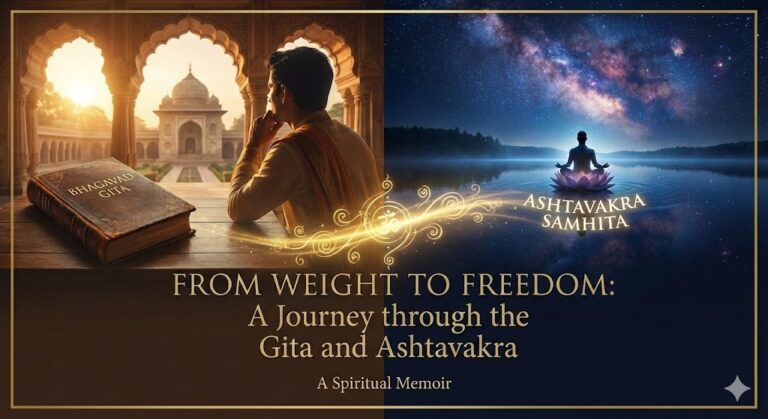
There was a time in my late twenties when life felt unbearably heavy. I was constantly chasing promotions, running from one deadline to the next, and measuring my worth entirely by outcomes. Stress was my default state. In those restless years, I found the Bhagavad Gita, almost by accident—and it changed the direction of my life.
Krishna’s words to Arjuna struck me with unexpected force:
“Perform your duty without attachment to the fruits of action.”
Until then, my world had revolved around results—the bonus, the praise, the next achievement. Learning to work for the sake of the work itself felt revolutionary. I began practicing Karma Yoga consciously. During a demanding project, I stopped obsessing over the final presentation and focused instead on the integrity of each step. Surprisingly, my anxiety began to dissolve. Success felt satisfying, failure felt manageable, and for the first time in years, I felt space inside my own mind.
Over time, I drifted toward a quiet form of Bhakti—not confined to rituals, but expressed through sincerity. My work became an offering, my effort a kind of devotion. The Gita taught me how to act with clarity, how to live with purpose, and how to stand steady in a turbulent world.
But as my life became calmer, another question slowly surfaced:
Who is this “I” that is acting?
Who is this “I” that is letting go?
That question carried me to the Ashtavakra Samhita. The shift was immediate and profound. If the Gita helped me build a meaningful and disciplined life, Ashtavakra shattered the illusion that the “builder” ever truly existed.
Ashtavakra’s words were direct and uncompromising:
“You are not the body nor the mind. You are pure Consciousness—ever free.”
This wasn’t guidance for action. It was a call to recognize what I already am. I found myself sitting in silence more often—not meditating with methods, but simply observing. Thoughts, emotions, sensations arose and faded on their own. I was the witness, untouched.
One quiet afternoon, as I watched leaves swaying outside my window, something shifted. There was no drama, no mystical vision—just a clear, simple truth. The sense of being a small, separate “me” dissolved. Everything—the leaves, the sky, the bird’s call, my breath—felt like one seamless presence. There was no experiencer and no experienced. There was only Experience.
A deep peace settled within—steady, quiet, unshaken by circumstances. The Ashtavakra Samhita had not given me a new identity; it had only removed everything false.
Looking back, my journey from the Bhagavad Gita to the Ashtavakra Samhita feels perfectly natural.
The Gita prepared the ground—discipline, clarity, dharma.
Ashtavakra revealed the sky—boundless, silent, ever free.
Today, I still live and work in the world, but the weight is gone. The “I” that once carried the world now knows itself as the space in which the world rises and falls. Nothing has changed, and yet everything is different.
I remain grateful—for the teachings, for the journey, and for the discovery of the freedom that was always, quietly, waiting within.
Krishna’s words to Arjuna struck me with unexpected force:
“Perform your duty without attachment to the fruits of action.”
Until then, my world had revolved around results—the bonus, the praise, the next achievement. Learning to work for the sake of the work itself felt revolutionary. I began practicing Karma Yoga consciously. During a demanding project, I stopped obsessing over the final presentation and focused instead on the integrity of each step. Surprisingly, my anxiety began to dissolve. Success felt satisfying, failure felt manageable, and for the first time in years, I felt space inside my own mind.
Over time, I drifted toward a quiet form of Bhakti—not confined to rituals, but expressed through sincerity. My work became an offering, my effort a kind of devotion. The Gita taught me how to act with clarity, how to live with purpose, and how to stand steady in a turbulent world.
But as my life became calmer, another question slowly surfaced:
Who is this “I” that is acting?
Who is this “I” that is letting go?
That question carried me to the Ashtavakra Samhita. The shift was immediate and profound. If the Gita helped me build a meaningful and disciplined life, Ashtavakra shattered the illusion that the “builder” ever truly existed.
Ashtavakra’s words were direct and uncompromising:
“You are not the body nor the mind. You are pure Consciousness—ever free.”
This wasn’t guidance for action. It was a call to recognize what I already am. I found myself sitting in silence more often—not meditating with methods, but simply observing. Thoughts, emotions, sensations arose and faded on their own. I was the witness, untouched.
One quiet afternoon, as I watched leaves swaying outside my window, something shifted. There was no drama, no mystical vision—just a clear, simple truth. The sense of being a small, separate “me” dissolved. Everything—the leaves, the sky, the bird’s call, my breath—felt like one seamless presence. There was no experiencer and no experienced. There was only Experience.
A deep peace settled within—steady, quiet, unshaken by circumstances. The Ashtavakra Samhita had not given me a new identity; it had only removed everything false.
Looking back, my journey from the Bhagavad Gita to the Ashtavakra Samhita feels perfectly natural.
The Gita prepared the ground—discipline, clarity, dharma.
Ashtavakra revealed the sky—boundless, silent, ever free.
Today, I still live and work in the world, but the weight is gone. The “I” that once carried the world now knows itself as the space in which the world rises and falls. Nothing has changed, and yet everything is different.
I remain grateful—for the teachings, for the journey, and for the discovery of the freedom that was always, quietly, waiting within.